

For twenty years, every buyer and seller I worked with wanted the same thing: less admin, more time to do the actual job.
We are finally there.
From data gathering, opportunity and risk identification, outreach automation, email scripting, all the way to negotiation and contract reviewing, the ways in which AI can be used and applied by sellers or buyers appear to be endless.
This should be fantastic news. Generations of buyers and sellers (me included) have always complained about the workload and operational tasks that held them back from selling and buying better.
And though, most of us are starting to feel miserable about it.
So what is happening on the ground?
Many procurement and sales teams find themselves in the AI efficiency trap. Instead of feeling liberated to do what they always wanted to do on their job, they feel stressed, burnt out and fear for losing their jobs.
What has gone wrong?
Many of us are in the AI Efficiency Trap
Cornelia Walther, a visiting scholar at Wharton, describes the AI efficiency trap as a predictable four-stage cycle. The initial productivity gains (stage 1) lead to a managerial recalibration of the organization (stage 2), which comes with escalating demands, which in turn requires the employees to increase their use of AI, which increases their dependency on it ultimately (stage 3). Each productivity gain becomes a new baseline and the organization becomes even more addicted to AI to keep up with the ever-accelerating efficiency gain expectations.
Critically, this cycle runs parallel to what Walther calls agency decay: the slow erosion of our ability to make our own decisions, and of our confidence that we still can without AI.
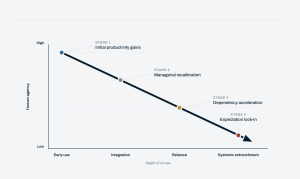
The psychological toll of this efficiency treadmill is becoming increasingly apparent in workplace research. Three in five workers now say they fear AI at work and expect it to make burnout worse, not better (Resume Now, March 2024). These statistics suggest that technology designed to reduce cognitive load is creating new forms of mental strain, rather than creating genuine opportunities for strategic thinking or professional development.
The trap has a cause, and we built it ourselves
How did we, as procurement and sales teams, get into this trap and vicious circle?
The main culprit? As buyers and sellers, we never defined what we would do if we had 20% more time in our workday. Did you?
AI gave us that instantaneously and we were not prepared for it. Think of it. We all had that “aha moment” when we first used AI for something that took us 2 hours previously and Claude did it in 20 seconds for us (I have a lot of Excel examples here to share). We were caught off guard.
We failed to articulate what we would do. So we landed in the efficiency trap of large organizations, which means, if you cannot defend how you use your freed-up resources yourself, you will get told, meaning: do more of the same work with fewer people.
The question that matters now
For as long as I sat on the buyer’s side of the table, information was leverage. The supplier who knew more than me had an edge. That edge is disappearing. When both sides can pull the same market data in seconds, knowing more than your customer stops being worth anything. What is left is whether you understand them, and whether they trust you.
All of us on the procurement and sales side should be able to say what we currently lack to become better at building winning B2B relationships. Better at selling great products and services to excited customers. Better at bringing the best supplier capabilities into our organization to drive growth and sales.
I know what I would have done as a buyer with 20% of my week back. I would have gone to the inception point of demand and finally understood the end consumer I was buying for. I would have walked a supplier’s production line instead of reading about it. I would have sat with the stakeholders I never had time for and asked what they actually needed. None of that shows up in an efficiency dashboard. All of it is where winning relationships are built.
The seller reading this can map every one of those across to their own week.
What we both, buyers and sellers, should do with the freed-up resources that AI gifted us is to better understand the value chain that we share between suppliers and customers to be able to meet needs more holistically, build stronger B2B partnerships, innovate quicker, anticipate risks earlier, and drive more profitable growth across company boundaries.
So, what are you waiting for?
Get out of the AI trap and define what you will do with the 5 minutes of reading time you saved by putting this article through Claude.
—-
My team and I at FIVIS train sales and procurement organizations to use their efficiency gains wisely, by building their strategic and analytical skills to focus on what matters most: their customers. If it is the direction your function needs to move, let’s talk: info@fivis.io


