

Sales managers are frequently told, “Just focus on value talking to customers.” However, even seasoned professionals can struggle to put this advice into practice.
Effectively articulating value is difficult because value perception among buyers is influenced by a combination of factors. Features of the product or service being sold, personal preferences of the buyer and organisational dynamics all influence purchasing behaviour in every business relationship. To build productive relationships, sales professionals must understand the relative importance of each of these aspects of value to their customer and effectively articulate this in communications. This is not an easy task.
Fortunately, there is a solid library of research we can draw on to better understand and express value, even when dealing with procurement professionals.
In this article, we’ll provide an overview of the research on perceptions of value among professional buyers. An overview of the three types of value in business relationships—exchange value, utility value, and psychic value (also known as buyer-specific perceptions of value) is presented. Then, we provide practical tips for how to identify the types of value most important to your customer and tailor your communication accordingly.
The 3 types of value that influence professional buyers
To begin, let’s look at the three types of value that influence the decisions of procurement professionals and professional buyers.
1. Exchange value
Exchange value represents the amount the customer pays for the product or service. This concept goes far beyond just the sticker price, taking into account factors like costs and margins for the organisation and customer search and acquisition costs.
Sales professionals in B2B settings should think of exchange value as the complete financial equation their customers consider. It includes the direct purchase price along with all associated costs, such as implementation, training, maintenance, upgrades, replacement, disposal, and more. Exchange value can also include opportunity costs (what the customer gives up by choosing your solution over alternatives).
For procurement professionals specifically, exchange value often extends to negotiated terms and conditions. Important considerations might be payment schedules, volume-based pricing structures, performance guarantees and potential cost escalations over the life of a relationship.
2. Utility value
Utility value describes the benefits customers derive from the product. Usefulness and practicality are primary components of utility value, but enjoyment and convenience are also relevant.
Considering the functional performance aspects of a product or service—or how well it solves the specific problem it was designed to address—is a good way to conceptualise utility value. For B2B buyers, this often translates to operational improvements, such as increased efficiency, higher quality outputs, enhanced reliability, improved safety, or expanded capabilities.
Beyond basic functionality, utility value encompasses the experience of using the product. This includes ease of implementation, user-friendliness, accessibility and the quality of ongoing support. Solutions that integrate seamlessly with existing workflows and require minimal training may provide higher utility value than those demanding significant operational adjustments.
Scalability and adaptability can also be an important aspect of utility value. Products that can flex with changing business needs, accommodate growth or address emerging challenges will usually deliver greater long-term utility.
3. Buyer-specific perceptions of value (BSPV)
While business purchases are often portrayed as purely rational decisions, research consistently shows that psychological factors—known as psychic value or BPSV—significantly influence even the most structured procurement processes.
BPSV encompasses a range of personal feelings arising from a transaction. Emotional and social factors mainly contribute to BPSV, with psychological needs such as buyer ego, hedonism, social status and career aspirations influencing purchasing behaviour.
The dimensions of value in BPSV operate on multiple levels in B2B relationships. At its most basic level, BPSV includes the buyer’s desire for a smooth, stress-free purchasing experience. Buyers may value suppliers who make their jobs easier, reduce their workload, or help avoid internal conflicts.
Professional reputation and career aspirations can also plan important roles in BPSV. Buyers might consider how a purchase decision reflects on their professional judgement and internal standing within an organisation, both of which can impact career trajectory.
Social dynamics within the buyers organisation create another layer of BPSV. Purchase decisions that align with the preferences of influential stakeholders, reinforce strategic relationships or demonstrate alignment with organisational values and priorities can provide significant personal value to the buyer.
Finally, risk perception may contribute to BPSV. Professional buyers particularly value suppliers who reduce their personal exposure to risk, whether through overt guarantees and assurances or a general sense of safety and confidence in the business relationship.
Piecing it together: Calculating total customer value
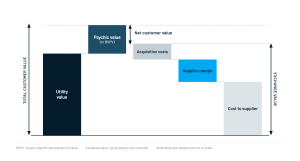
The image above (adapted by Aitken & Paton, originally from Azaddin Salem Khalifa) provides a visual representation of how different types of value contribute to the total and net value experienced by a buyer. Bear in mind that the relative contribution of each value type differs according to individual circumstances, so the proportional effects above serve as examples only.
To effectively communicate value, it’s crucial to understand how the three types of value contribute to the total benefit your customer derives from your product. To gain this knowledge, sales professionals must thoroughly explore and assess what constitutes value from the customer’s point of view, examining each domain separately and then as a whole.
Most buyers have a dominant focus on one aspect of value. However, other dimensions of value still significantly influence purchasing decisions.
For best results, sales professions must anticipate the dominant value for the buyer, developing a proposal that optimally addresses this key need, while also sufficiently covering secondary value dimensions.
Practical guidelines for selling value
In this section, we’ll use quotes and indicators to illustrate how a buyer might signal they are focused on a particular value dimension. Then, we provide practical advice on how sales professionals can articulate and demonstrate value in each domain.
Exchange value indicators
- A statement like, “We need to understand the total cost of ownership, not just the initial purchase price,” indicates the buyer may be focused on exchange value.
- Price is an aspect of exchange value, so a buyer requesting a discount may be focused on exchange value.
- A buyer discussing concerns about ancillary costs, such as training, maintenance, compliance or disposal is a good indicator that exchange value may influence their decisions.
How to demonstrate exchange value
When articulating exchange value, effective sales professionals quantify both direct and indirect financial benefits. This might include calculating total cost of ownership, return on investment, payback periods or opportunity costs. Remember that financial metrics resonate differently for each stakeholder. For example, a CFO will usually be more focused on capital expenditure and depreciation, while an operations manager might care more about ongoing maintenance costs and productivity improvements.
The most convincing exchange value propositions are those backed by concrete data and realistic projections. Developing a customised financial model for your buyer that clearly demonstrates cost savings or revenue improvements over time are especially powerful. When doing this, be sure to incorporate all relevant factors, such as implementation costs, training requirements, maintenance fees and productivity impacts.
Be prepared to discuss creative pricing structures that align with your buyer’s financial constraints and objectives when communicating about exchange value. The goal is to demonstrate not just the value of your solution, but flexibility in structuring a deal that caters to your customer’s financial needs. Remember that procurement professionals often evaluate multiple options simultaneously, so clearly articulating your financial advantage over competitors is vital.
Utility value indicators
- A real-world utility value could be, “If you can give me a product at £10 and deliver it on time, that’s better than a product that costs £6 but is late.”
- When a buyer questions your track record of competency, like asking for evidence of industrial equipment being installed and commissioned correctly, that’s a clear indicator that utility value is important.
- A buyer who is influenced by utility value may spend a significant portion of time discussing future-state scenarios and scalability, testing to see if your organisation is likely to be a good long-term partner.
How to demonstrate utility value
The defining feature of utility value is that it relates directly to the buyer’s use of a product. A good way to narrow in on expressing this type of value is to ask yourself, “How does my buyer benefit from my product?” You might also ask, “How well does this solution work well for its intended purpose?”
To effectively demonstrate utility value, sales professionals should focus on concrete evidence rather than abstract claims. Case studies from similar organisations, live demonstrations and proof-of-concept trials are all powerful tools. Where possible, allow buyers to experience your solution firsthand, so they develop confidence in your ability to deliver on promised functionality and outcomes.
Time-related benefits form another important dimension of utility value. Solutions that save time, accelerate processes, reduce delays, or extend productive capacity all deliver tangible utility benefits. Similarly, solutions that improve resource utilisation—whether through reduced waste, better energy efficiency, or optimised labour allocation—provide measurable utility advantages that matter to operational stakeholders. For technical solutions, you may need to consult with subject matter experts from your organisation to guide your communications.
Finally, remember that utility value often extends beyond the initial purchase decision. Articulating how you’ll ensure sustained performance through maintenance, updates and ongoing support helps your customer feel confident that your product service will meet their needs over the long-term.
Buyer-specific perceptions of value (BSPV) indicators
- A buyer who seems preoccupied with how the deal will be perceived by internal stakeholders is likely focused on BPSV. This may show up as statements like, “It’s going to be a hard sell to get the CFO to agree to this.”
- BPSV isn’t always verbally communicated. For example, you may notice that a buyer responds particularly well to efficient, no-fluff meetings and fast transactions. This could either be due to their personal preferences or a sign that they have many competing priorities.
- An example statement indicating BSPV through seeking status or career advancement would be, “Our CEO is pushing this initiative, so we need something impressive that demonstrates our ability to innovate.”
How to demonstrate exchange value
As a general rule, perceptions and preferences around BSPV can be more difficult to identify than other value dimensions. This is primarily because aspects of BSPV often aren’t directly articulated and may even operate at a subconscious level for the buyer.
To understand BSPV in a sales relationship, one must pay close attention to the personal priorities of the buyer. This begins with active listening during conversations to identify cues about what matters to the buyer as an individual. Look for signals about their risk tolerance, career aspirations, relationship dynamics within the organisation and personal values. Building rapport through authentic relationship development creates an environment where the buyer is more likely to share these less obvious but highly influential personal motivations.
Once you understand the BSPV factors that matter to your buyer, incorporate them thoughtfully into your value proposition. Strategies for specific aspects of BSPV include:
- Career-focused buyers – highlight how your solution can enhance their internal visibility and status within the organisation.
- Risk-averse buyers – emphasise guarantees, implementation support and contingency planning.
- Buyers dealing with organisational challenges – provide materials and messaging that help your buyer build consensus and navigate organisational dynamics.
Remember that addressing BSPV often requires subtlety. Explicitly acknowledging these factors can sometimes make buyers uncomfortable. Instead, show that you understand their personal situation through your actions.
Putting it into practice: How to effectively communicate value
Understanding the three dimensions of value—exchange value, utility value, and buyer-specific perceptions of value (BSPV)—provides sales professionals with an effective framework for connecting with professional buyers. Rather than a one-size-fits-all approach to value selling, this evidence-based perspective allows for more nuanced and persuasive communication.
The research findings presented in this paper confirm what many experienced sales professionals already understand: exchange value often dominates purchasing decisions, but other aspects of value are still highly influential. Furthermore, individual buyers vary substantially in their value priorities.
For sales professionals looking to improve their effectiveness at selling value, it’s necessary to first identify your buyer’s dominant value orientations. Then, use this information to craft a comprehensive proposal that demonstrates how your solution meets their primary and secondary value-related expectations and needs. By developing your ability to articulate all three dimensions of value effectively, you’ll build stronger relationships with customers and achieve better business outcomes for both parties.
Sources:
Aitken, A & Paton, RA 2016, ‘Professional buyers and the value proposition’, European Management Journal, vol. 34, no. 3, pp. 223-231.
My team and I at FIVIS train sales organizations to articulate value in a way that matters to their customers. If it is something you struggle with, let’s talk: info@fivis.io


